
Primary Phone: (262) 880-8206 Office Phone: (262) 800-1074

Meet the Owner, Russ Paddock II
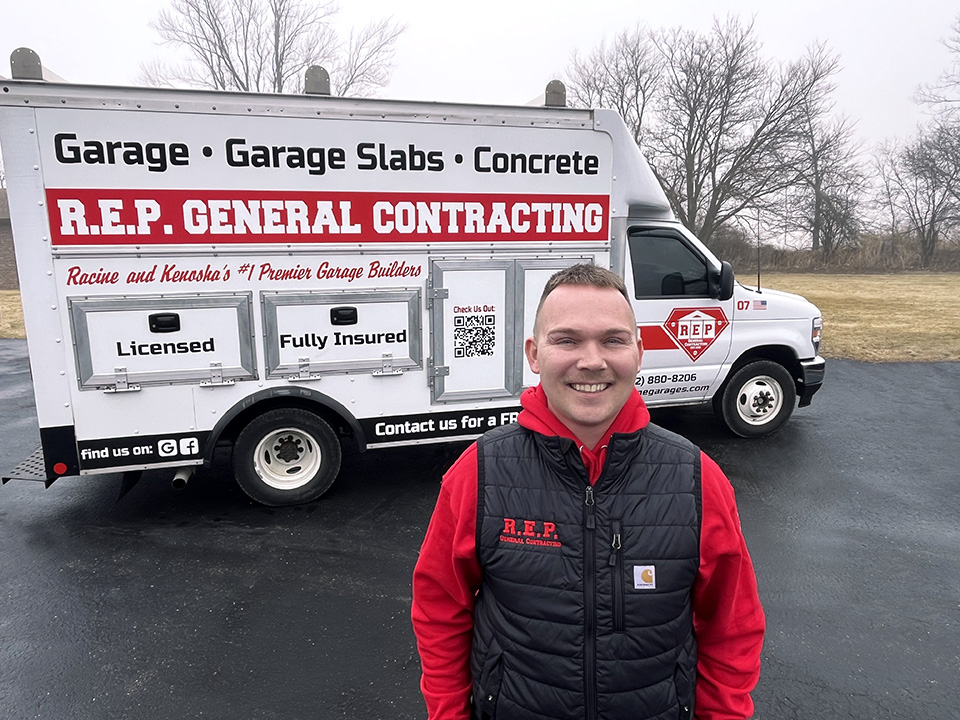
"I’ve spent over 30 years building in the Racine and Kenosha area, and if there’s one thing I’ve learned, it’s that a garage is one of the biggest investments you’ll make in your home. You deserve to know exactly who is stepping onto your property and the philosophy behind the work we do.
I sat down to answer the ten most common questions I get from homeowners. From how I handle the Wisconsin frost to why I still love setting trusses after three decades in the business. I hope this gives you a clear look at the 'R.E.P. Standard' and the experience I bring to every job site."
1. What made you decide to specialize specifically in garage building and concrete work in the Racine and Kenosha area?
"I grew up in the industry, following in my father’s footsteps. It didn't take long to realize there was a real need for specialized custom garage construction right here in Racine and Kenosha. What truly intrigued me about this field was the complexity and variety of the work. Constructing a garage isn't just one task; it’s an education in how a structure comes to life.
I love that my days are never repetitive. One day, I’m focused on the precision of concrete and framing, and the next, I’m moving into siding and shingles. Being able to master every phase of the project, from the foundation to the finish, allows me to ensure every garage we build is constructed to the highest standard."
2. How has the Wisconsin climate shaped the way you handle concrete pours and garage foundations?
"In Wisconsin, the weather is the single most important factor we consider when installing foundations and slabs. Because of our intense freeze and thaw cycles, the ground is constantly expanding and contracting. If a foundation isn't built to handle that movement, it won't last.
That’s why we take a strategic approach to our schedule and our process. For example, we generally advise against pouring concrete after Thanksgiving or once the first deep freeze cycle has hit. Our foundations are the most crucial part of our entire garage package. Everything we build on top—the framing, the siding, the roof—is only as good as the slab it sits on. We prioritize longevity by working with the Wisconsin climate, not against it.”
3. In your 30+ years of experience, what is the most common mistake you see homeowners make when planning a new garage?
"The most frequent mistake I see is homeowners building a garage that is too small for their long-term needs. People often think about the car they drive today, but they forget to measure for future possibilities, such as a larger SUV, a boat, or recreational vehicles.
Over my 30 years in the industry, I’ve learned that a garage isn't just a place to park, it’s a functional space. I always encourage my clients to physically measure their vehicles and consider their storage needs before we break ground. My goal is to make sure that five or ten years down the road, you aren't wishing you had added those extra few feet of length or width."
4. What does the ‘R.E.P. Standard’ look like during a typical construction project?
"The R.E.P. Standard stands for Reliable, Experienced, and Professional. To me, that means going above and beyond the industry norm. It starts with being fully licensed, insured, and BBB-accredited, so my clients have total peace of mind the moment we step onto their property for a new garage construction project.
The standard is also about communication. We don’t just build; we educate. I make it a priority to inform my clients about the different types of materials available and, specifically, which ones are engineered to thrive in the Wisconsin climate. Our goal is to provide a level of transparency and expertise that sets us apart from the competition, to ensure you feel confident in both the process and the finished product."
5. What are the benefits to the customer of having a dedicated crew for concrete and a different dedicated crew for the garage builds?
"Efficiency and quality control are at the heart of our 'separate division' approach. Many contractors try to be 'jacks-of-all-trades,' but I believe that having specialists leads to a superior finished product.
My main concrete crew members have been with me for 12 years, and each brings over 30 years of individual experience to the job site. They live and breathe concrete, whether they are pouring concrete driveway slabs or the foundation for a new build. On the other side, my garage crew has the specific expertise required of detached garage builders to construct anything from a simple one-car garage to a complex five-car structure.
By having the right individuals for the right job, each crew can focus entirely on their specific craft without sacrificing quality elsewhere. This specialization ensures a much smoother transition between the foundation and the framing, giving our customers a level of workmanship that most of our competitors simply can't match."
6. What is your philosophy on communication once a project actually begins?
"My philosophy is simple: when a client commits to R.E.P., I commit my time to them. That commitment starts from the very first handshake when I provide a free estimate or a detailed garage project quote. The number one complaint in this industry is a lack of communication, so I make it a point to be the exception.
I maintain a direct line of communication with every homeowner. My phone is always on, whether it’s for a formal change order or just a small question about the scope of work. As the owner, I take a hands-on approach to every construction project. I believe that being present and accessible on the job site isn't just a benefit to the build, it’s essential for the client's peace of mind. When you work with us, you’re never left wondering where your project stands."
7. How do you help homeowners navigate the complex permit and zoning requirements in Mount Pleasant, Pleasant Prairie, or Kenosha?
"Navigating the red tape of local municipalities can be a headache for homeowners, but it’s a part of the job I handle every day. Over the last 30 years, I’ve built strong, professional relationships with building inspectors across Mount Pleasant, Caledonia, Somers, Waterford, Burlington, and the Town of Paris. Because of the high volume of garages we construct annually—whether it's a complex garage replacement or a brand-new build—I know the 'ins and outs' of the permit application process for each specific area. Some townships have more rigorous zoning requirements than others, but we are always up for the challenge. Having a direct line to the local building departments allows me to proceed efficiently, ensuring your project meets all codes and gets approved without unnecessary delays."
8. When a client is torn between a detached garage and an attached addition, what factors do you help them consider?
“The biggest factor is almost always the budget. In most cases, there is a $10,000 to $20,000 price difference between the two. An attached addition requires deep footings and poured-wall foundations to meet residential codes, whereas a detached garage can often be built on a high-quality slab.
Beyond the foundation, you have to consider the ‘tie-in.’ Attaching a structure to your home means reworking the existing roofline and often re-shingling large portions of the house to ensure everything matches. With a detached garage, we only have to focus on the new structure. I help my clients weigh that cost-to-value ratio: do you need the convenience of an attached space, or would you rather put that $20,000 toward a much larger, more versatile detached building?”
9. What part of the building process do you still find the most rewarding after three decades in the business?
“Even after 30 years, there is still nothing quite like the day we set the trusses. It’s that pivotal moment where the project stops being a foundation and starts looking like a building. Seeing all the different phases, like the concrete, the framing, and the engineering, finally come together to reach the finish line is incredibly rewarding. I still take a lot of pride in stepping back at the end of a project and seeing a high-quality structure that I know will serve that family for decades.”
10. What should a Racine or Kenosha resident expect during their initial free estimate with you?
“When you book a free estimate, you can expect me—the owner—to personally come out to your property. I don’t send salespeople. I want to be there to ‘pick your brain’ and ask the right questions so we can account for every variable of your project.
Following our meeting, you will receive a formal, comprehensive written quote within 7–10 business days. Unlike a simple total estimate, I provide a full line-item breakdown of the project and a specific list of the types of materials we will use to construct your garage. I want you to see exactly where your investment is going and the high quality of the materials we furnish for every build. My goal is to give you a clear, professional roadmap so you know exactly what to expect from start to finish.”